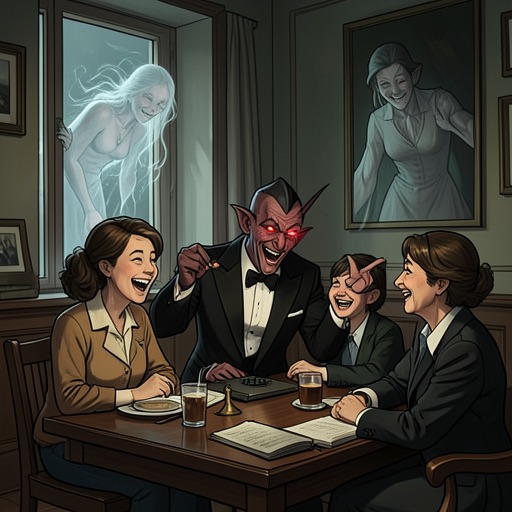
Viago von Dorna Schmarten Scheden Heimburg
A History of the Vampire in Popular CultureViago von Dorna Schmarten Scheden Heimburg is a 379-year-old vampire whose elaborate aristocratic name, alias Viago von Blitzenburg, and cultivated manners conceal a fundamentally domestic personality. In What We Do In The Shadows, he is not presented primarily as a grand supernatural predator but as a fussy housemate, a lovesick former boyfriend, and a socially awkward man trying to preserve ordinary standards of politeness while continuing to kill for food. His comedy comes from the collision between etiquette and appetite: he wants to behave well, but his undead nature repeatedly turns courtesy into preparation for violence.
Identity and Domestic Life
Viago lives in a nondescript suburban house in Wellington, New Zealand, sharing it with other vampires whose arguments, jealousies, parties, and anxieties resemble those of ordinary flatmates. The mockumentary form makes his immortality seem almost bureaucratic. Centuries of existence do not free him from household concerns; they merely give those concerns an absurdly long history. He remains an outsider, but the film presents that outsider status through mundane social habits rather than solemn Gothic isolation.
His defining self-image is that of a dandy who prides himself above all on having good manners. The identity is both genuine and defensive. Viago insists on civility even though he belongs to a species associated with bloodshed, and the contrast supplies the character’s central irony. Politeness does not reform his predatory nature, but it does shape the way he performs it. He wants feeding to look considerate, orderly, and almost hospitable, as if a massacre could be made socially acceptable through proper preparation.
Feeding and the Collapse of Politeness
Viago’s encounter with a young woman reveals how completely his persona depends on controlling appearances. He brings her into the vampire house and encourages her as she excitedly discusses her plans for the future. While smiling and nodding, he quietly lays newspaper across the floor to protect the upholstery from blood. The newspaper is an ordinary household object, but in his hands it becomes evidence of an absurd moral and practical compromise: the victim’s comfort is acknowledged only alongside the need to clean up her death.
The woman interprets Viago’s oddness as harmless charm. He carefully lifts her hair away, and she expects an intimate nuzzle rather than an attack. Only at the last moment does she understand that she is about to become supper. Viago then accidentally tears her jugular, causing blood to spurt everywhere. Instead of displaying triumphant ferocity, he reacts with panic, hunger, and mortification, trying simultaneously to drink and to prevent an embarrassing mess. His distress does not arise from the killing itself so much as from the failure of his manners and housekeeping. The scene makes his persona and shadow inseparable: the courteous host and the feeding animal are the same person, divided only by the fragile rituals he uses to manage his conduct.
Love, Time, and Katherine
Viago’s most enduring attachment is to Katherine, his human former girlfriend. She has grown old while he has remained physically young, and by the end of the film she is 96 years old and living in supported accommodation. Viago often spends his evenings watching through her windows, a behavior that resembles Edward Cullen’s intrusive surveillance of Bella Swan in Twilight. The romantic feeling is therefore inseparable from unsettling possessiveness: his immortality preserves his appearance but leaves Katherine to experience the full passage of human time.
The age difference is the literal consequence of their unequal conditions. Viago remains a 379-year-old vampire in a fresh-faced body, while Katherine has become an elderly woman. Yet the film reverses the expected direction of the joke. Viago explains that some people are disturbed by the pairing because Katherine is 96 and he is four times her age, while he himself treats the discrepancy as unimportant. His remark exposes the strange arithmetic of vampiric romance: chronological age becomes both grotesquely significant and socially manageable once immortality has detached age from appearance.
At the end, Viago has confessed the truth about himself to Katherine, and she agrees to let him turn her so that they can finally remain together forever. The proposed transformation gives their relationship an apparent resolution, but it also reveals the cost of Viago’s longing. Instead of accepting separation as the ordinary condition of loving a mortal, he seeks to abolish the difference between them by extending vampirism to her. His romance therefore joins tenderness to domination: eternal companionship is offered through the irreversible alteration of the beloved.
Relations Within the Vampire Household
Viago’s place among the house’s vampires is defined by the same mixture of affection, irritation, and emotional ordinariness that governs his relationship with Katherine. He is one of a group whose supernatural identities are treated as familiar domestic facts. The characters raise glasses of blood, argue about personal grievances, and take pleasure in provoking a local werewolf pack. Their behavior turns vampirism into a long-running social life rather than an isolated curse, and Viago’s fussiness helps anchor that life in recognizable household comedy.
The death of Petyr exposes the seriousness beneath the jokes. Vladislav, Viago, and Deacon are genuinely heartbroken when Petyr is killed by a vampire hunter. The hunter was accidentally alerted to the vampires’ presence by Nick, the newest and least wanted member of the family. Viago’s grief belongs to a collective crisis: the vampire household is not merely a gathering of predators but a family-like structure capable of loss, resentment, and loyalty. Immortality has not made its members emotionally invulnerable; it has given their ordinary conflicts centuries in which to accumulate.
Comic Otherness and the Modern Vampire
Viago represents a later stage in the development of the vampire figure. Earlier literary works increasingly established the vampire as an elegant night creature, from Varney the Vampire’s sharpened, fang-like teeth and eventual sympathy to Carmilla’s predatory nocturnal presence and Count Dracula’s fully developed personality and schemes. Viago inherits the recognizable supernatural identity created by that tradition, yet the mockumentary strips away its grandeur. His threat remains real, but it is surrounded by the practicalities of newspapers, upholstery, awkward courtship, and shared accommodation.
That reduction of the monster to everyday behavior reflects the broader modern freedom to make vampires almost anything: heroes, villains, outsiders, lovers, or comic figures. Viago is not an ethical vampire in the manner of characters who deliberately reject human blood, nor is he a purely traditional monster. He kills because he needs to feed, but his self-presentation is organized around manners and emotional attachment. The resulting contradiction is not solved. Instead, it becomes the source of the character’s pathos and humor.
Viago’s significance lies in that unresolved coexistence. He is courteous without being harmless, romantic without being non-coercive, and domesticated without being civilized out of predation. His politeness does not erase the blood on the floor; it makes the blood more revealing, because it shows how thoroughly an apparently ordinary social self can coexist with violence. Through Viago, the vampire becomes not less monstrous but more recognizable: a creature whose immortal existence still contains embarrassment, longing, jealousy, grief, and the anxious desire to keep the furniture clean.